Georgia Tech · Reasoning and Learning Group
CreSTAL · In-Silico Materials-Targeting RL
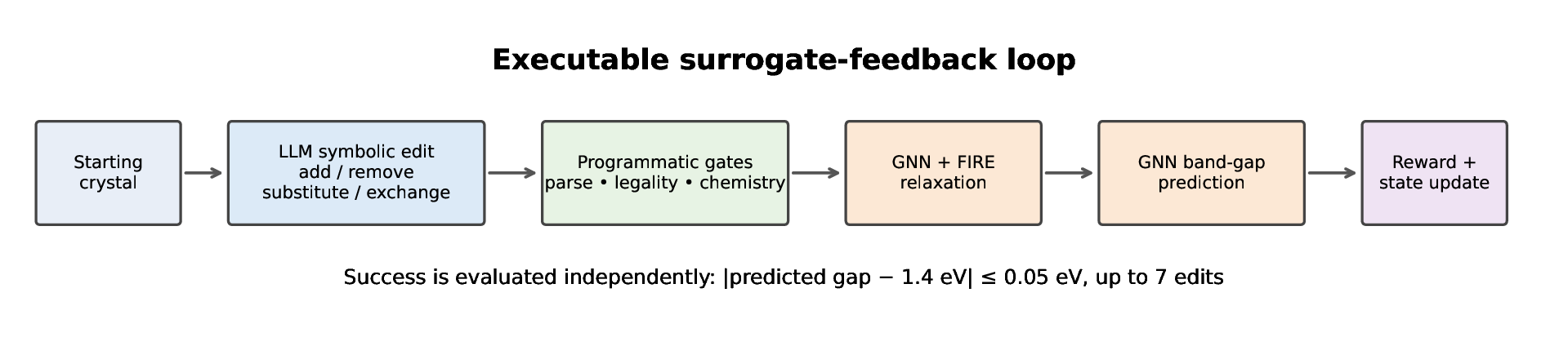
An executable materials-editing environment for studying post-training and reward design in open-weight language models. A model proposes symbolic crystal modifications; programmatic checks filter the proposals before learned-force-field relaxation and GNN scoring; and the evaluation asks whether the predicted band gap reaches a fixed target.
From proof of concept to study
I first used Qwen3-0.6B as a proof of concept to validate the end-to-end materials-editing and tool-calling loop. That model is outside the paper's benchmark. The reported study scaled the experiments to Qwen3-4B, Minitron-4B, Llama-3.2-3B, and Phi-4-mini.
Problem
Executable rewards can make a language-model policy easier to optimize without improving the strict task that matters. CreSTAL studies that gap in an in-silico materials-editing setting. The task is to move each starting material's predicted band gap to 1.4 eV, within ±0.05 eV, using up to seven sequential symbolic edits.
System
At each step, the model emits an add, remove, substitute, or exchange operation. Programmatic checks evaluate the format, operation, and chemistry, while a reward-relevant but non-fail-stop geometry check evaluates the candidate. A MatDeepLearn force field performs ASE/FIRE structure relaxation, and a GNN surrogate predicts the band gap. Those checks and property signals become feedback for GRPO training. The resulting certificate is relative to the implemented surrogate environment, not a DFT, experimental, or physical-materials certificate.
Evaluation protocol
The benchmark evaluates 1,000 materials drawn from an 8,680-material Materials Project pool, disjoint by material ID from training and balanced across four initial-gap strata. Each material receives one stochastic trajectory. The main study compares base, supervised fine-tuned, and GRPO-post-trained checkpoints under the same evaluator, target, edit budget, and success tolerance. It measures three different things: continuous surrogate utility and progress, near-target landing within ±0.10/±0.20 eV, and strict success within ±0.05 eV.
| Model | Base | SFT | Smooth Progress–Proximity RL |
|---|---|---|---|
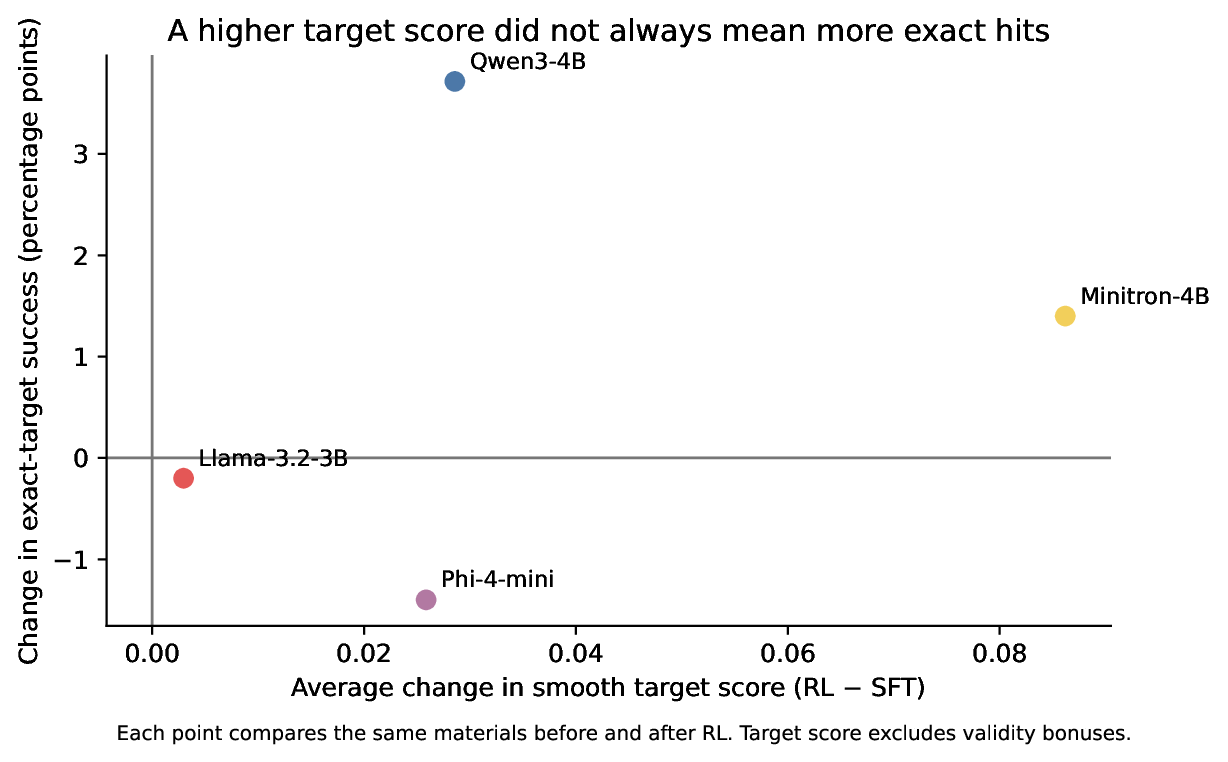
| Qwen3-4B | 12/1000* | 111/996 (11.1%) | 148/1000 (14.8%) |
| Minitron-4B | 12/1000* | 121/1000 (12.1%) | 135/1000 (13.5%) |
| Llama-3.2-3B | 12/1000* | 121/1000 (12.1%) | 119/1000 (11.9%) |
| Phi-4-mini | 12/1000* | 118/1000 (11.8%) | 104/1000 (10.4%) |
* Base hits are the same 12 materials that began inside the target band; base models executed zero successful modifications. Qwen SFT has 996 evaluated materials.
Result: reward and task success can diverge
Held-out smooth property utility increased after RL for all four models, but strict target success varied by model. Qwen rose from 11.1% after SFT to 14.8% with the original reward; Minitron rose from 12.1% to 13.5%, while Llama and Phi declined slightly. This identifies a mismatch between reward improvement and strict task success under this protocol, not evidence that one model or reward is generally superior.
I tested three reward formulations with Qwen3-4B: Smooth Progress–Proximity, Progress–Success with a strict-target bonus, and Tiered Target with progressively narrower target bonuses and reduced validity credit. Strict success was 14.8%, 15.6%, and 15.7%, respectively, compared with 11.1% after SFT. These were single adaptive runs, so the differences do not establish reward superiority.
My role
As a co-first author and researcher, I built and maintained the end-to-end SFT/GRPO post-training pipeline, materials-editing environment integration, data-generation pipeline, and evaluation and regression checks. I also orchestrated distributed training and rollout generation across four H100 workers, worked through tokenizer, log-probability, and GPU-utilization failures, and contributed to the manuscript's analysis. The linked writing captures several of those debugging investigations; the benchmark results represent the broader team's work.
Limitations
- The study uses one training run and one stochastic trajectory per material.
- The learned surrogate both supplies reward information and defines success; its reported MAE of approximately 0.28 eV exceeds the ±0.05 eV target band.
- Edited structures were not independently evaluated with DFT or experiment, and the environment does not certify physical materials.
- GRPO optimizes single-step edits while evaluation composes up to seven edits.
- The Qwen reward follow-ups are adaptive and non-confirmatory; only one band-gap target is evaluated.